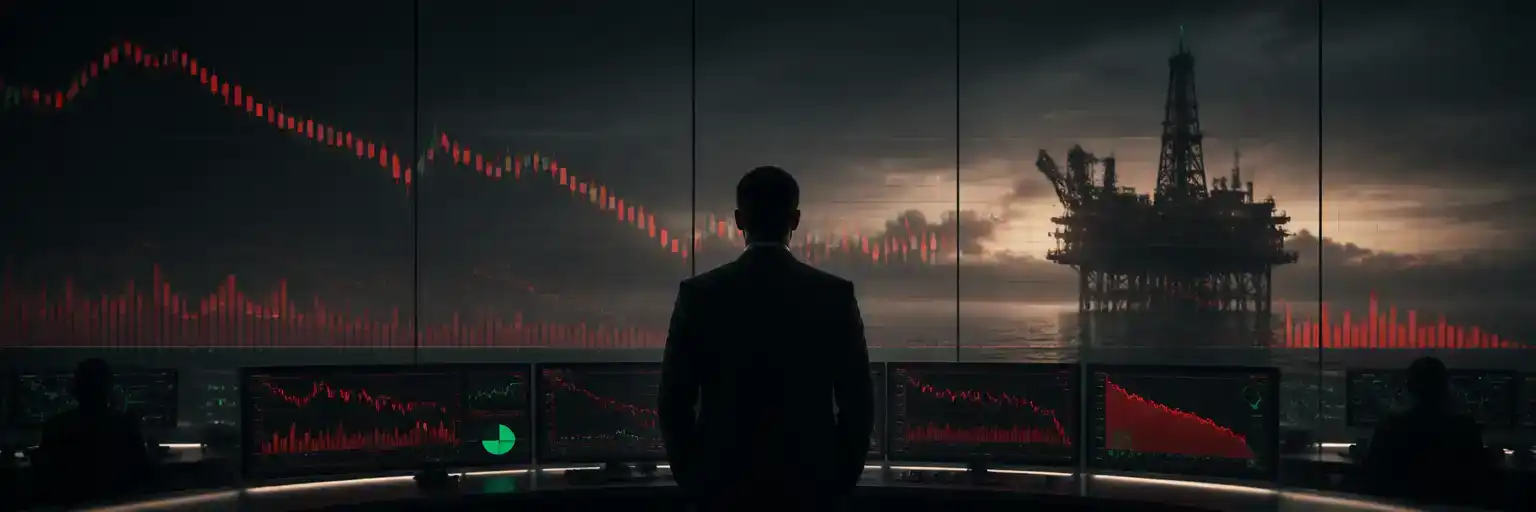
Meta beat on revenue and still fell: the market is pricing AI capex
A 26% revenue jump wasn't enough. With capex at $34.9 billion and free cash flow negative, investors are asking AI spenders for proof of returns.
Photo: Intel Free Press / Wikimedia Commons (CC BY 2.0)
What does it take for a company to grow revenue 26%, beat estimates, guide above consensus and still get sold off? Spend like Meta just did. The lesson of this earnings season is not that the AI story is over. It is that the market has stopped accepting "trust us" as a line item.
Meta reported third-quarter revenue of $64.6 billion, up 26%, and capital expenditures of $34.91 billion, according to New York Post's report on the results. Free cash flow was negative $2.12 billion, versus positive $10.63 billion a year earlier. The shares first rose after hours, then reversed. As investingLive noted, they were down more than 7% intraday on Thursday, so the final close may differ.
The ad machine isn't the problem; the cash bill is
Nobody can credibly argue that Meta's core business is weak. Ad impressions rose 10% and the average price per ad rose 14%. Excluding a nearly $10 billion legal charge, earnings per share would have been $7.40. On trailing earnings the stock looks cheap.
But earnings are not cash. Capex went from $19.4 billion a year ago to $34.9 billion, and the company's cash and marketable securities of $82.4 billion now sit next to $83.7 billion of debt. A filing, as investingLive reports, disclosed about $825 billion in future commitments for data centers, energy and compute. We would treat that last figure as the real headline, because it turns a spending choice into a contractual obligation.
Our reading: the market is not punishing AI. It is repricing Meta from a cash-printing ad business into a capital-hungry infrastructure company. That deserves a lower multiple, and it is a fair trade-off until returns are visible.
"Trust us" gets weaker when the funding gets creative
The timing of the new non-voting Class C shares did not help. Meta says the purpose of the structure, effective January 19, 2027, is to give it the ability to finance its growth, and press reports note it preserves Zuckerberg's leadership of the company. Investors reasonably read it as a tool that could be used to issue stock. That is an interpretation, not something Meta has announced, but it is a natural one when free cash flow is negative.
To be fair, management made a case. Zuckerberg said more than 10 million people in the U.S. and Canada set up Muse agents in about six weeks, and about 25% use it on a given day, per TradingView's call summary. Meta also expects to improve Muse's compute-cost efficiency more than tenfold over the next year. These are promising signs. But Muse is not yet launched globally, and Meta says the broader AI revenue opportunity will develop over multiple years. Spending is front-loaded; revenue is early. The gap between the two is exactly what the market is now charging for.
Index holders should look at the concentration, not just at Meta
The sell-off did not stay with one stock. The same coverage describes Nvidia, AMD and memory makers falling, and a Nasdaq drop of 2.3% intraday. One Spanish outlet also highlighted record S&P 500 concentration in the tech giants.
That is the point for anyone holding a broad index. If a few companies make up a large share of the fund, you own their capex cycle whether you intended to or not. When all of them are spending at this scale, one disappointing return signal can hit several holdings at once. This is not a call to sell, and we cannot know where prices go next. It is a call to check how much of your portfolio really rides on one theme, and whether that matches your time horizon and tolerance for drawdowns.
Our verdict
The correction looks healthy rather than catastrophic. For two years, the question was who would spend the most. Now it is who can show the best return per dollar. Meta has real evidence in advertising, and early evidence in Muse. It does not yet have the proof that justifies a build-out of this size without leaning on investors' patience.
Practical takeaway: be skeptical of any AI narrative that cannot show cash. Watch free cash flow, financing choices and commitments, not just revenue beats. And if your core holding is a market-cap-weighted index, remember that diversification on paper can be concentration in practice. This is general analysis, not personalized advice.
No topics yet: start the first one.
More stories
A dot-com-level CAPE won't time the market, but it should change your math
The Shiller CAPE at 40.58 is a bad crash alarm but a useful reality check: trim the assumption of 10% annual returns and rebalance without panic.

The AI sell-off is Wall Street sending Big Tech the bill
Meta beat on revenue and still saw its stock sold off. With free cash flow negative, investors look to be treating AI capex as a cost that has to earn its keep.

Gold isn't losing its shine: rate bets are doing the damage
Gold hit a two-month low as oil-fueled inflation pushed rate-hike bets higher. The metal's safe-haven role isn't broken, and chasing this dip looks like the wrong lesson.

Oil and AI spending are one trade problem, not two
Thursday's sell-off paired a jump in crude with fresh AI spending jitters. Both hit the same crowded tech trade, so check your concentration before trying to time any dip.