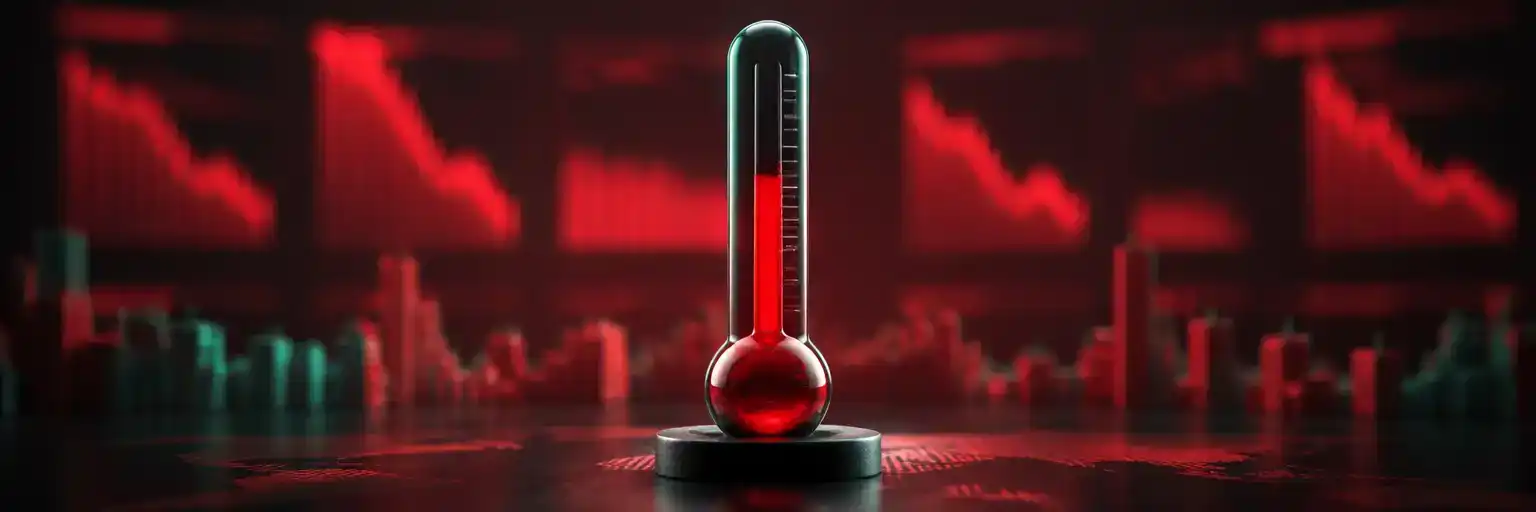
A 156-year stock market warning with six data points isn't a forecast
A signal seen only six times in 156 years makes a scary headline but thin evidence. Use it as a prompt to check concentration, not as a reason to time the market.
Photo: forextime.com / Wikimedia Commons (CC BY 2.0)
How worried should you be about a warning that has appeared six times in 156 years? Our answer: a little, and in a very specific way. Not worried enough to sell. Worried enough to look at what you actually own.
The signal is the subject of a headline from AOL on November 27: "The Stock Market Is Flashing a Signal Seen Only 6 Times in 156 Years", which adds that history suggests certain stocks could take the biggest hit. The excerpt we have doesn't spell out the indicator's mechanics, so we won't pretend to explain them. What we can say is the context: the same day, Wall Street was rallying.
According to Quartz's report on futures, Dow futures rose 683 points, with the index on pace for its best week since April 2025. Nasdaq-100 futures advanced 2.4%, and Nvidia, Meta and CoreWeave led the move. A rare alarm and a euphoric tech rebound on the same morning: that is the tension worth discussing.
Six observations is a story, not a statistic
Start with the math of common sense. Six events across 156 years cannot tell you much about what happens next. Each episode almost certainly came with its own interest rates, its own geopolitics, its own technology and its own market structure. Any pattern drawn from six cases is easy to fit after the fact and hard to trust before it.
Rarity also seduces us. "Only seen six times" sounds like precision, but it mostly tells you the sample is tiny. If a coin landed heads on four of six flips, nobody would call it a law. We'd say the same here: treat it as a curiosity with a dramatic wrapper, not as a crash call.
There's a second problem. A signal that fires rarely can't be tested the way investors need, with many cycles and out-of-sample checks. You can't build a timing strategy on something you will use maybe once in a career, and being early on a warning costs real money if the market keeps climbing.
The useful part is the "which stocks" question
The headline's second half is the interesting one: which stocks would suffer most? That is a question about concentration, and it's answerable without any crystal ball.
This week's rally was tech-led. Nvidia drove Monday's surge, according to a report on the week's gains, and the same names keep leading on Friday. Anyone holding a broad index fund is probably carrying more exposure to a handful of tech and AI names than they realize. That, in our view, is the real risk to inspect, whether or not the signal ever proves right.
Another note of caution comes from the same market commentary: strategists quoted by one outlet warn that fears of Federal Reserve rate hikes, echoing 2018, may decide whether the Black Friday tech rally lasts. That is a plain, nameable risk. It's also one more reason not to read a single rare indicator as destiny. Markets move on rates, earnings and sentiment, and a handful of historical coincidences sits far below those in the hierarchy of evidence.
What to do with it
We'd suggest three modest steps, none of them investment advice. First, look at your top holdings, including those inside funds, and see how much of your portfolio rides on one theme. Second, check that your allocation matches the time you have before you need the money; if a 20% drop would force you to sell, the problem is the plan, not the signal. Third, if you want to rebalance, do it on a schedule rather than in response to a headline.
What we wouldn't do is sit in cash waiting for a seventh sighting. A strong week, even one on pace to be the Dow's best in 19 months, isn't proof of safety either; it just means the market is jumpy in both directions, and Friday's session was shortened and volatile.
Our verdict: the signal is a caution flag, and a weak one. Its best use is as a nudge to audit concentration and risk tolerance. If that audit makes you uncomfortable, you've learned something real, and you didn't need 156 years of history to learn it.
No topics yet: start the first one.
More stories
The S&P 500's best week in 19 months is a bounce, not a new regime
A violent AI-led rebound repairs sentiment, but it leaves the rate and AI-spending questions behind November's rout untouched. Chasing it is the wrong lesson.
S&P's Nvidia warning shows governance is a priced risk
A rating agency says Nvidia's board may have compromised its independence and its CEO is a key-man risk. For index investors holding the megacap, that's not a footnote.

The Dow's 1,100-point round trip hid the real story: higher for longer
A green close masks hot inflation, new tariff proposals and a Fed that may have less room to cut, so stress-test your portfolio instead of cheering the rebound.
A fear-gauge "buy signal" tells you about mood, not about the bottom
A spike in fear gauges says investors are scared, not that the sell-off is over. With AI valuations and sticky inflation in play, use any such signal to audit your plan.